|
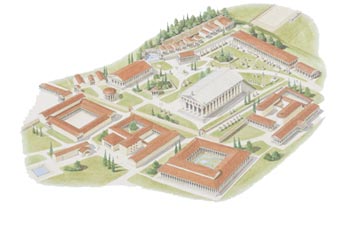
Temple of Zeus at Olympia
The massive temple of Zeus, the most important building in the Altis,
standing in its very centre, is the largest temple in the Peloponnese,
considered by many to be the perfect example of Doric architecture. It
was built by the Eleans from the spoils of the Triphylian war and
dedicated to Zeus. Construction began c. 470 and was completed before
456 BC, when an inscribed block was let into the east gable to support
a gold shield dedicated by the Spartans in commemoration of their
victory at Tanagra.
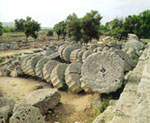
Temple of Ηera at Olympia
The temple of Hera, one of the oldest monumental temples in Greece,
stands in the north-west corner of the sacred precinct of the Altis,
on the south slopes of Kronios hill, protected by a powerful terrace
wall. It was dedicated to the Olympian sanctuary by the inhabitants of
Skillous, an ancient city of Eleia. Pausanias relates that the temple
was built approximately eight years after Oxylos ascended to the
throne of Elis, that is c. 1096 BC, but in reality it is much later.

Bouleuterion of Olympia
The bouleuterion, or Council House, one of the most ancient and
important buildings of the sanctuary of Olympia, was the seat both of
the Elean Senate, whose members were responsible for the organisation
of the games, and possibly of the hellanodikai, or umpires. This is
where the athletes registered and drew lots, and where their names and
the program of events were announced. It was also where any offences
and pleas were tried, and where penalties were decided.
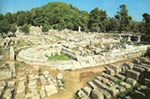
Prytaneion of Olympia
The Prytaneion, one of the oldest and most important buildings at
Olympia, was the administrative centre of the sanctuary's political
life and of the Olympic Games. It was the seat of the magistrates, the
high officials who oversaw the sacrifices performed monthly to honour
the gods; Pausanias (V, 15, 8) refers to it as the 'Prytaneion of the
Eleans'. The Prytaneion occupied the north-west corner of the sacred
enclosure, directly opposite the gymnasium.
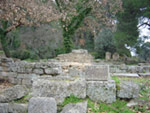
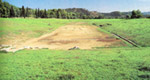
Ancient stadium of Olympia
The stadium of Olympia, situated east of the sacred Altis enclosure,
was where the ancient Olympic Games and the Heraia, the women's games
in honour of Hera, were held. Before the sixth century BC the running
events were held on a flat area along the treasuries' terrace, east of
the great altar of Zeus. A first stadium (Stadium I) was formed in the
Archaic period (mid sixth century BC) by leveling the area south of
the Kronios hill inside the Altis.
Ancient gymnasium of Olympia
The ancient gymnasium of Olympia lies north-west of the Altis
enclosure on a flat stretch of land by the Kladeos river bank. It is
adjacent to the palaestra, which extends the gymnasium complex towards
the south. Here athletes practiced track and field and the pentathlon.
Before the construction of the gymnasium in the Hellenistic period,
these events took place outdoors. The surviving structure dates to the
second century BC.

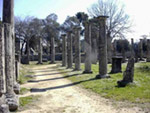
Palaestra of Olympia
The palaestra is situated west of the Altis enclosure, near the
Kladeos river. Built in the third century BC as part of the gymnasium
complex, it was used to practice boxing, wrestling and jumping.
This almost square building (66.35 x 66.75 metres) stands 0.70 metres
lower than the gymnasium. At its centre was an open court, forty one
metres square, surrounded by a Doric colonnade of 72 columns and laid
with fine sand on which the athletes trained.
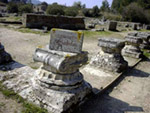
Leonidaion
The Leonidaion, situated at the south-west corner of the sanctuary,
outside the sacred precinct of the Altis, was a large and luxurious
hostel for distinguished visitors to the Olympic Games. It was built
in approximately 330 BC and was remodeled twice in Roman times. A
dedicatory inscription partially preserved on the epistyle of the
outer Ionic stoa records that the building was erected by Leonidas son
of Leotas from Naxos, who was both architect and benefactor.
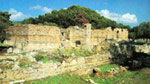
Workshop of Pheidias
West of the sacred enclosure, directly opposite the temple of Zeus,
was the workshop of Pheidias where the great sculptor crafted the
gigantic chryselephantine statue of Zeus, listed as one of the Seven
Wonders of the ancient world. The building was erected in the second
half of the fifth century, when Pheidias, after completing the
sculptures for the Athenian Acropolis, went to Olympia to work on the
statue of Zeus. Excavation finds and pottery date it precisely to
430-420 BC.
Theokoleon
West of the sacred enclosure and north of the workshop of Pheidias
lies the Theokoleon. This was the seat of the theokoloi, the priests
of Olympia, but also the residence of the sanctuary staff, which
included soothsayers, interpreters, bearers of sacrificial animals,
musicians and a woodmonger who provided the wood used in sacrifices.
The original structure dates to the mid-fifth century BC, but was
later remodeled and enlarged more than once.
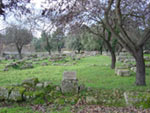
Zanes
Immediately outside the Krypte, the entrance to the stadium and along
the treasury terrace is a row of sixteen pedestals, which supported
the Zanes. These were bronze statues of Zeus, none of which has
survived, created from the fines imposed on athletes for cheating at
the Olympic Games. Their prominent position was intended to dissuade
other athletes from cheating. According to Pausanias (V, 21, 2-18),
the first of the Zanes were erected after the ninety-eighth Olympiad
in 388 BC
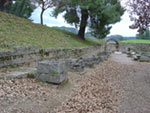
Philippeion
The Philippieion, the only circular building inside the Altis, is one
of the finest examples of ancient Greek architecture. Located west of
the temple of Hera, it was dedicated to Zeus by Philip II of Macedon
after his victory at Chaironeia in 338 BC, proving the important
political role of the sanctuary at that time. After Philip's death in
336 BC, the monument was completed by his son, Alexander the Great,
who had the statues of his family crafted by the famous sculptor
Leochares.
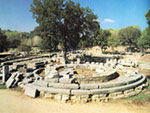
Pelopion
South of the Heraion was the Pelopion, a funerary monument (cenotaph)
dedicated to Pelops, a much venerated Elean hero. According to
Pausanias (V, 13, 1) this monument was dedicated by Hercules, a
descendant of Pelops. Beneath the Pelopion lies a prehistoric tumulus
(Early Helladic, approximately 2500 BC) and its enclosure. The
earliest structure inside the Altis, its top was still visible in the
Classical period.
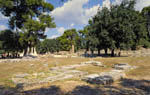
Baths
The earliest baths of the sanctuary are situated near the bank of the
Kladeos river. They were named Greek baths so as to be distinguished
from the baths of the Roman period. The original structure, which
dates to the fifth century BC, was gradually remodeled and enlarged.
The Greek baths were probably abandoned in the Roman period when
several other bath complexes were built inside the sanctuary.
Leonidaion baths
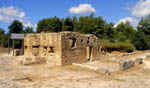
The so-called Leonidaion baths, situated outside the south-west corner
of the Altis, owe their name to the nearby guesthouse (though the two
buildings were not related). This well-preserved monument is unique in
Olympia in that it preserves its original height and roof. Built in
the third century AD, it remained in use until the sixth century and
was remodeled several times.
|